
What Happens to Our Brain When in Survival Mode
Research About the Brain
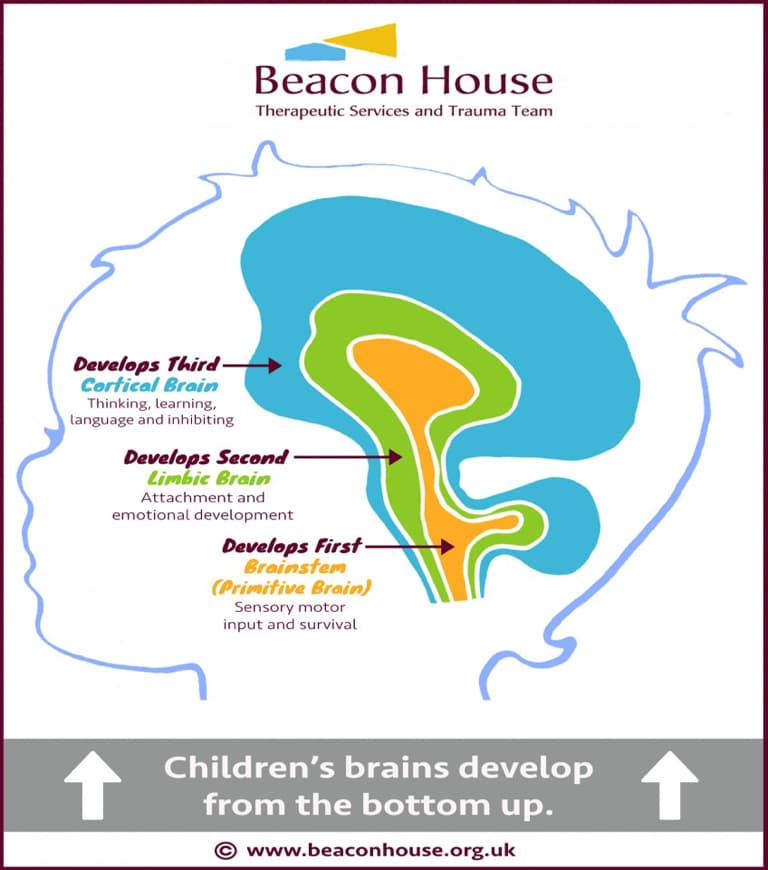
Research tells us that when young people have experienced trauma, they are working from the primitive part of the brain (bottom), which controls your fight, flight, and freeze response.
During this time, they are not able to access the higher regions of the brain that control emotional regulation and cognitive learning.
They will also have higher levels of cortisol running around their bodies, which is your stress hormone. Because of this, the thinking region of the brain is unresponsive and they are not able to make rational decisions or think about consequences.
The hippocampus is smaller and its structure is interrupted (Wilson et al., 2011; McCrory et al, 2010). This can affect attention, learning and memory (Hedges and Woon, 2011; Pechtel and Pizzagalli, 2011).
Changes to the amygdala function (Wilson et al., 2011; Pechtel and Pizzagalli, 2011). This can cause children to struggle to regulate their emotions. In particular, for children who have experienced trauma, their amygdala becomes sensitive to a perceived threat and so the survival response is likely to be triggered by less and less stress.

What Is the Amygdala?
It is a collection of cells near the base of the brain. This is where emotions are given meaning, remembered, and emotional memories are formed.
The amygdala is key to how we process strong emotions, such as pleasure and fear. Early humans were under the constant threat that they may be harmed or killed by wild animals or other humans.
To increase the chances of survival, human bodies evolved the fight or flight response. It’s an automatic response to physical danger that enables you to react quickly without thinking. This is the role the amygdala plays.
When you perceive a threat in the environment the amygdala will jump into action and send out signals to release stress hormones that prepare your body to fight or run away.
Dr Bessel Van der kolk...
Dr Bessel van der Kolk is a professor of psychiatry and one of the worlds leading experts on traumatic stress. He has provided us with up to date research and described the amygdala as being like a smoke detector when it is sent messages from the “watchtower”, which is the prefrontal cortex located directly above the eyes.
Think Fire...
If you feel in danger, your amygdala prepares you for fight, flight, or freeze. If this is a false alarm, and your not too upset, your prefrontal lobes can restore your balance by making sure you realise the danger has passed.
This part controls your conscious thinking so you can observe what is going on, predict what will happen, and make mindful and calm choices.
This capacity is crucial for maintaining relationships with other human beings. As long as the prefrontal lobes are working correctly, we’re unlikely to get upset and lose our temper if someone looks at us the wrong way or if someone is running late.
However, if these are working incorrectly, the system can break down.
Flipping Your Lid…
Do you ever see young people and adults just “Flip their lid” for no apparent reason?
Did it leave you wondering what happened, what was the trigger?
When the amygdala is in overdrive, we become like conditioned animals and the moment we detect danger we automatically go into fight and flight mode.
This is unconscious thinking and this is why sometimes following an episode of extreme challenging behaviour, a young person won’t know why this has happened as they were being driven from the primitive part of their brain.
At these times the brain only gives us two ways to regulate:
Top-down relating to learning awareness of body sensations. This helps to ground us, recognising it’s our fight and flight response kicking in.
Bottom-up involves senses, movement, meditation and breathing.
Think! What are your strategies following a stressful day/week?
Dr. Dan Siegel's Hand Model of the Brain
The Repair of Early Trauma: A Bottom Up Approach
The Window of Tolerance Animation by Beacon House
Sensory Overload
(To Support understanding of how it can feel when our brains are overloaded)
How the Brain Works
Emotions and the Brain
Palix Foundation / Alberta Family Wellness Initiative: How Brains Are Built
How to Map Your Own Nervous System: The Polyvagal Theory
